The Dining Room
The plasterwork ceiling and frieze, with attenuated acanthus, paterae and urns, are a modern interpretation of Wyatt’s work of the late 1770s. The contemporary chimney-piece, with inlaid marble fluting and a central plaque of Diana the Huntress, was brought from a house in London, demolished in the 1930s.
Furniture, Ceramics, Glass and Silver
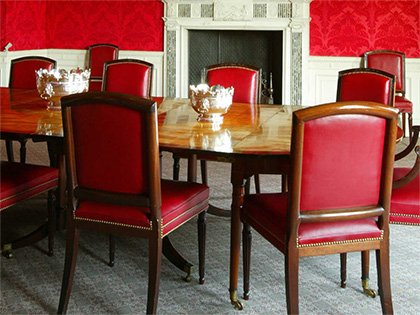
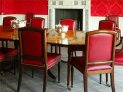
The late eighteenth-century extending dining-table and the leather-covered chairs, part of an exceptionally large set, were commissioned by Thomas Chinton, 3rd Duke of Newcastle (b.1794), for Clumber Park in Nottinghamshire, a house later demolished in 1938. The mahogany table displays highly unusual figuring bordered by a band of inlaid rosewood.
The mahogany side-tables are attributed to the designs of Robert Adam, and were purchased by the 2nd Lord Faringdon in 1953 to fit the curved recess, a typical feature of Adam’s dining rooms. They were previously at 20 St James’s Square, London during the tenancy of the 14th Earl of Strathmore and Kinghorne and his daughter Lady Elizabeth Bowes-Lyon, who later became Queen Elizabeth, consort of George VI and mother of Elizabeth II.
The three Japanese Imari dishes on the left side-table are part of a set of four (the fourth is on the far table in the West Passage) and date to around 1700. The pair of Chinese iron red and gilt ovoid vases and covers on the right side-table are eighteenth-century.
On the bow-fronted mahogany sideboard are a number of pieces of early eighteenth-century Chinese Export armorial porcelain, bearing the arms of Stephen Sulivan, a director of the East India Company and an ancestor of Lord Faringdon.
Either side are a pair of William IV cut glass five light candelabra c. 1830. They are part of a group of lighting supplied to the 6th Duke of Devonshire in 1831 for use in his London residence, Devonshire House, along with at least three chandeliers, one of which hangs in the Drawing Room at Buscot Park. They were supplied by London’s leading manufacturer of chandeliers, W. & H. Perry, which provided fittings for royal residences such as Carlton House and the Royal Pavilion, Brighton. This pair was purchased by the Trustees of the Faringdon Collection at the Chatsworth Attic Sale organised by Sotheby’s in October 2010. The left-hand candelabra has been extensively restored.
The chandelier is a fine example of English red flushed overlay (strawberry glass) of about 1860. On the mantelpiece is a French nineteenth-century clock with a barley-sugar glass mechanical waterfall.
Pictures
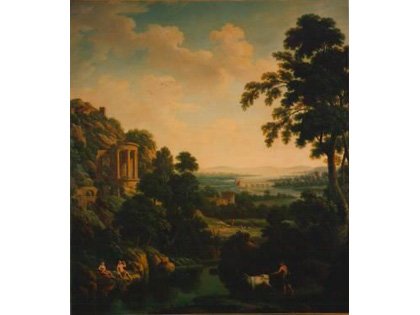
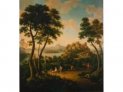
The painting above the sideboard is by the Welsh landscape painter Richard Wilson and has been identified from a bill in Sir Watkin Williams-Wynn’s possession as A View in the Villa Chigi at Ariccia (no.18). It was originally part of Sir Watkin's collection at this country house in north Wales, Wynnstay.
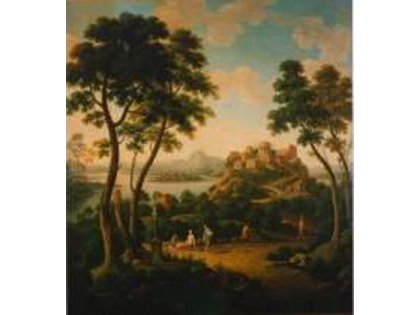
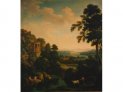
George Lambert, one of the earliest painters of natural landscape in England, is represented above the Adam tables by a pair of classical views belonging to the category of copies and variants that he made of Claude and Gaspard Poussin (nos. 98, 99).
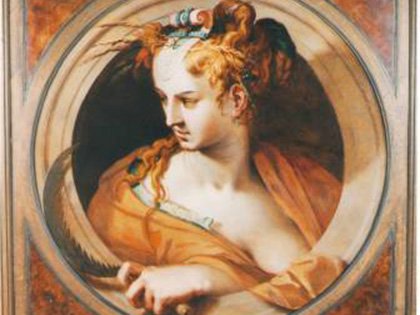
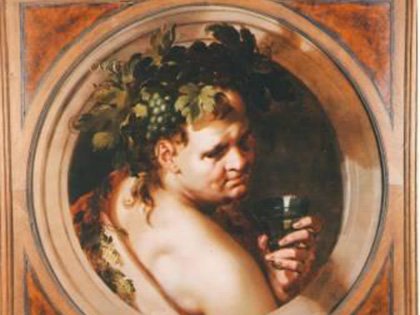
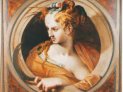
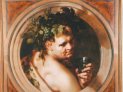
On either side of the fire place are two of the earliest known oil paintings by Abraham Bloemaert: Ceres was purchased in 1993, and now for the first time in many years it may be viewed with its companion tondo Bacchus, as originally intended (nos. 184 and 181). Over the mantelpiece is Roelandt Savery's Temptation (no. 21) dated 1620.
The rare pair of Chinese Imperial kingfisher feather panels above the doors to the Saloon are eighteenth-century and came from the Ionides Collection. The panel on the left depicts a phoenix standing beneath leafy maple trees surrounded by bamboo, rockwork and lingzhi and showing the moon in the night sky. The right hand panel depicts phoenix standing beneath bamboo trees surrounded by rockwork. The zitan frames are carved with peaches, bats, lingzhi and other auspicious Chinese symbols.


 For Visually
 Print
Print View Map
 = House & Grounds Open
 = Grounds Open Only
 = Closed

 >
>
