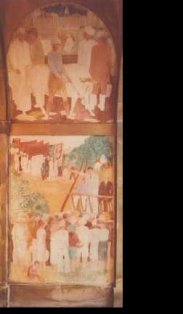
One of John Hastings' mural scenes depicting Buscot's Farm Manager and a political rally

One of John Hastings' mural scenes depicting Buscot's Farm Manager and a political rally

Returning towards the house, note the arch in the pavilion that stands to the east of the house. This leads through to an outdoor swimming-pool, and the paintings on the walls and vaulting of the archway are of particular interest. Painted by John Hastings (who later became the Earl of Huntingdon) at some time in the late 1930s, they portray friends of the 2nd Lord Faringdon, and some of the Buscot Park staff.
Lord Faringdon himself is portrayed as a young man addressing a political rally in the scene on the left (as you face the pool), while above is a portrait of Mr Cowdray, Buscot’s Farm Manager, leading a prize bull, and Mr Bastion, the Head Gardener, with some exotic blooms. John Hastings’ self-portrait is in the adjacent roundel, and the lady portrayed in the roundel opposite is Susan Lawrence, one of the first women Labour MPs and chairman of the Labour party from 1929 to 1930. Two other well-known figures portrayed here are Lord Berners, who lived at Faringdon House nearby, and Lady Violet Bonham-Carter, both of whom are among the guests of Lord Faringdon seated at dinner.
 = House & Grounds Open
 = Grounds Open Only
 = Closed


 >
>

 For Visually
 Print
Print View Map