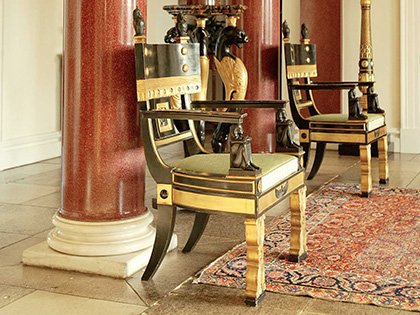
Pair of ebonised and gilt chairs from the Thomas Hope suite
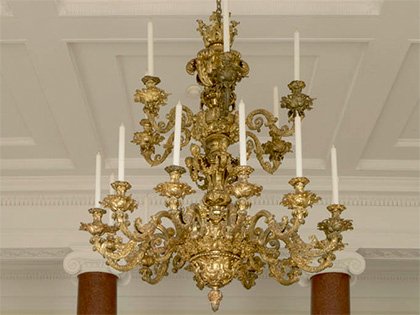
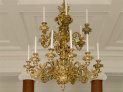
The entrance hall's gilt-metal chandelier from Barnsley Park
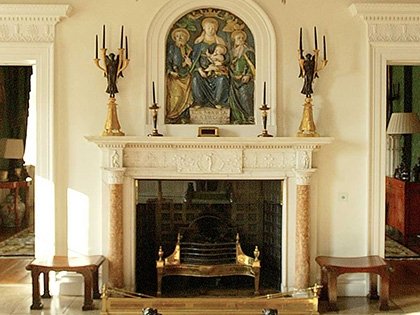
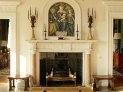
The chimney-piece with its della Robbia glazed ceramic panel
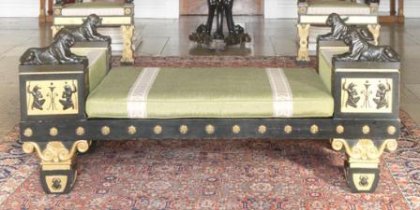
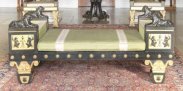
Low couch from the Thomas Hope suite

Pair of ebonised and gilt chairs from the Thomas Hope suite
The entrance hall's gilt-metal chandelier from Barnsley Park
The chimney-piece with its della Robbia glazed ceramic panel
Low couch from the Thomas Hope suite
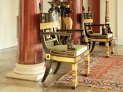
The waxed stone flags and the porphyry scagliola pillars date from the 1780s, and are part of Edward Loveden Loveden's original house. The remainder of the decorative scheme here is due to the 2nd Lord Faringdon, who inherited Buscot in 1934, and who acquired the celebrated suite of Thomas Hope furniture especially for this room.
The marble chimney-piece is close to a design by James Wyatt and probably executed by Richard Westmacott the Younger. It is thought to have come from a house in Portman Square.
The painted panels and trompe l’oeil trophies were painted for Lord Faringdon by Roy Hobdell in 1950.
Sculpture
Over the chimney-piece is a glazed terracotta panel representing the Virgin and Child flanked by Saint Peter and Saint Paul, attributed to the Buglioni workshop, principal rivals to the Della Robbia workshop in 16th century Florence. The life-size alabaster statue of Apollo, wearing a gilt-bronze laurel wreath, which occupies the niche on the opposite wall, is also probably Florentine, of around 1600. The two nineteenth-century fans either side of Apollo depict classical scenes from Rome.
Furniture and Ceramics
Most of the furniture here is of the Regency period, and reflects the revival of interest in that style in the inter-war years. The large ebonised and gilt couch, and the pair of chairs standing in front of the scagliola pillars, are in the Egyptian taste that became fashionable after the battle of the Nile (1798). They, together with the ebonised and gilt torchères, were made for Thomas Hope, the pioneer of Regency furniture design, and are illustrated in his Household Furniture and Interior Decoration (1807) as part of the furnishing of the ‘Egyptian Room’ at Duchess Street, his London residence off Portland Place. The tripod-stand behind the couch, ebonised and gilt, with lion monopodia supports, is in the manner of George Smith, the cabinet-maker whose pattern book of 1808 (A Collection of Designs for Household Furniture and Interior Decoration) did much to popularise the Regency style. This stand (a gift from the late George Levy of Blairmans) supports a clock in the Egyptian taste designed and illustrated by Thomas Hope. The greyhounds were commissioned from Jonathan Sainsbury in 2017 by the Faringdon Collection Trust. They were copied from a pair of greyhounds designed by Thomas Hope, now at Temple Newsam, Leeds, and originally forming the ends of a couch.
Flanking the entrance is a pair of Empire mahogany jardinières with ormolu mounts in the manner of Jacob-Desmalter. On the wall above them are a matching clock and barometer of the Louis XIV period of a model traditionally attributed to André-Charles Boulle (1642–1732), celebrated for his brass-inlaid work. Interestingly, the thermometer used is that invented in 1730 by René Antoine Ferchault de Réaumur (1683–1757), which has a scale divided into 80 degrees between freezing and boiling point. Such scales are very rare, and were only used for just over a decade, since it was rapidly superseded by the 100-degree scale devised in 1742 by Anders Celsius (1701–44). The scale on the clock is also that of Réaumur, expanded to cover the range minus 40 to plus 80 degrees (zero to minus 40 is inscribed ‘Water Freezes’, 10 to 25 is inscribed ‘Caves Prof’ (short for Caves Profondes, or ‘Deep Cellars’), the acceptable range for cellar temperatures, while 25 to 40 is marked as ‘Temperate’ and 80 is inscribed ‘Limit of Boiling Water’).
At the far end of the Hall is a pair of ormolu-mounted French Empire side-tables in mahogany with marble tops. The tables carry Empire figures of kneeling cupids in ormolu, and Sèvres bleu celeste shell-shaped dishes of 1756, which were originally simply painted with flowers, but when mounted in ormolu, the turquoise grounds and bird paintings were added (perhaps by Edward Holmes-Buldock c.1830). Beneath the tables stand two Chinese eighteenth-century sang-de-boeuf vases.
The gilt-metal chandelier was originally at Barnsley Park in Gloucestershire (a house that still belongs to the Faringdon family) and was almost certainly supplied to Sir James Musgrave, Bt. (d.1814), between 1806 and 1809 when John Nash was engaged to remodel that house. Nash was probably also responsible for introducing the chandeliers of similar design at St. James’s Palace. Inspired by the designs of André-Charles Boulle, these chandeliers reflect the contemporary taste for French fashions led by the Francophile George, Prince of Wales, later George IV.
The pair of amboyna and giltwood tables, with pineapple motif stems, supporting seventeenth-century panels of Genoese marquetry, reflect the antiquarian taste that became fashionable under the Prince Regent's influence, and were bought at the Hartwell House sale in the 1930s. The ormolu candelabra on the mantelpiece, their four-branched lights supported by winged figures of Victory, are French of the Empire period, in the manner of Thomire. Either side of the chimney-piece are two eighteenth-century gout stools.
 = House & Grounds Open
 = Grounds Open Only
 = Closed


 >
>

 For Visually
 Print
Print View Map